
Caleb University VC delivers keynote address at Tunde Bakare’s Citadel School graduation
 The establishment of the Citadel School of Government has been described as a timely intervention in Nigeria’s leadership development space, offering structured training aimed at equipping participants with the competence, character and courage required for public service and nation-building.
The initiative aligns closely with broader efforts to strengthen leadership capacity across Africa through values-driven education, practical governance exposure and ethical formation.
In his keynote address titled: "Leadership, Innovation and Institutional Excellence: Preparing Change-Makers for a Competitive and Disruptive World," the Vice-Chancellor challenged the pioneer graduands of the school to reject leadership driven by personal ambition and instead commit themselves to building enduring institutions capable of outliving individual office holders.
The Professor of Strategy and Entrepreneurship declared that Nigeria's greatest developmental challenge is not the absence of human or natural resources but the persistent weakness of institutions, policy implementation and ethical leadership.
He maintained that sustainable national development can only be achieved through strong institutions founded on integrity, accountability, innovation, transparency and strategic long-term planning.
In one of the most compelling moments of the lecture, Asikhia presented a comprehensive, data-driven analysis of Nigeria's governance ecosystem using international governance indices, corruption perception reports, institutional performance assessments and global competitiveness rankings.
He argued that rebuilding public confidence requires leaders who possess vision, competence and the courage to strengthen systems rather than personalise power.
The establishment of the Citadel School of Government has been described as a timely intervention in Nigeria’s leadership development space, offering structured training aimed at equipping participants with the competence, character and courage required for public service and nation-building.
The initiative aligns closely with broader efforts to strengthen leadership capacity across Africa through values-driven education, practical governance exposure and ethical formation.
In his keynote address titled: "Leadership, Innovation and Institutional Excellence: Preparing Change-Makers for a Competitive and Disruptive World," the Vice-Chancellor challenged the pioneer graduands of the school to reject leadership driven by personal ambition and instead commit themselves to building enduring institutions capable of outliving individual office holders.
The Professor of Strategy and Entrepreneurship declared that Nigeria's greatest developmental challenge is not the absence of human or natural resources but the persistent weakness of institutions, policy implementation and ethical leadership.
He maintained that sustainable national development can only be achieved through strong institutions founded on integrity, accountability, innovation, transparency and strategic long-term planning.
In one of the most compelling moments of the lecture, Asikhia presented a comprehensive, data-driven analysis of Nigeria's governance ecosystem using international governance indices, corruption perception reports, institutional performance assessments and global competitiveness rankings.
He argued that rebuilding public confidence requires leaders who possess vision, competence and the courage to strengthen systems rather than personalise power.
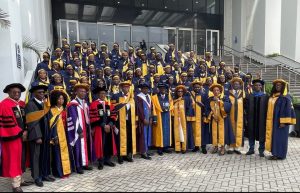 The VC urged the graduands to embrace ethical leadership, servant leadership, innovation, evidence-based policymaking, digital transformation, institutional excellence, strategic foresight and policy entrepreneurship.
He stressed that future leaders must become solution providers capable of identifying governance gaps, designing innovative policies and building coalitions that produce measurable national impact.
Drawing lessons from the remarkable transformations recorded in Singapore, Rwanda, Germany, South Africa and the United States, Prof. Asikhia demonstrated how visionary leadership, institutional reforms, investment in education, technology, entrepreneurship and human capital have enabled nations to overcome significant historical challenges and achieve sustainable development.
He emphasised the indispensable role of universities and leadership institutions in producing competent leaders, insisting that higher education must move beyond awarding certificates to deliberately developing character, courage, innovation, ethical values and practical problem-solving capacities required for nation-building.
He further challenged educational institutions to become incubators of leadership excellence by producing graduates capable of influencing governance, strengthening public institutions, stimulating economic growth and driving sustainable development across Africa.
The VC urged the graduands to embrace ethical leadership, servant leadership, innovation, evidence-based policymaking, digital transformation, institutional excellence, strategic foresight and policy entrepreneurship.
He stressed that future leaders must become solution providers capable of identifying governance gaps, designing innovative policies and building coalitions that produce measurable national impact.
Drawing lessons from the remarkable transformations recorded in Singapore, Rwanda, Germany, South Africa and the United States, Prof. Asikhia demonstrated how visionary leadership, institutional reforms, investment in education, technology, entrepreneurship and human capital have enabled nations to overcome significant historical challenges and achieve sustainable development.
He emphasised the indispensable role of universities and leadership institutions in producing competent leaders, insisting that higher education must move beyond awarding certificates to deliberately developing character, courage, innovation, ethical values and practical problem-solving capacities required for nation-building.
He further challenged educational institutions to become incubators of leadership excellence by producing graduates capable of influencing governance, strengthening public institutions, stimulating economic growth and driving sustainable development across Africa.
Related stories
Degrees open doors, skills sustain it,’ DVC RISA admonishes final year students at Caleb University Employability Fair
The Deputy Vice-Chancellor for Research, Innovation, and Strategic Advancement (RISA, Caleb University, Lagos, Prof. Adesola Adetutu Ajayi , on Tuesday charged students to build their futures by developing practical skills and strong professional networks. She made the call in her welcome address at the 2026 Employability Fair, Theme: "Beyond the Degree: Unlocking Skills, Networks, and Opportunities for a Dynamic Job Market," organized by the university for its final year students. The employ...
Company CEOs to storm Caleb University for 2026 Employability Fair
At least 40 company chief executive officers and industry leaders will storm Caleb University, Lagos, this week for the 2026 Employability Fair. The employability fair, also known as a career fair or job expo, provides the final year students of the university with the unique opportunity to meet employers, recruiters, and training providers to find jobs, build professional networks, and improve work skills. The forum will also enable the students to talk face-to-face with company hiring teams...
Caleb University Strengthens Its Commitment to Climate Action
Caleb University continues to strengthen its commitment to sustainability and climate action through initiatives that promote environmental responsibility across the University community. The University is committed to advancing sustainable practices, raising climate awareness, and encouraging students, staff, and the wider community to take positive action towards a more sustainable future. Through its teaching, research, campus operations, student engagement, and community initiatives, Cale...